Choosing the right profile extrusion type begins with the product’s function, not its appearance. A window seal, conveyor guide, medical tube, and cable channel may all require different extrusion strategies. Profile Extrusion shapes continuous polymer sections through a custom die, creating consistent lengths with carefully controlled dimensions. Small changes in wall thickness can affect cooling, shrinkage, flexibility, and final assembly.
This guide examines the leading types, including solid profiles, hollow profiles, co-extruded designs, foam profiles, and application-specific shapes. Each type offers practical advantages. Hollow sections can reduce material use, while solid profiles often provide greater impact resistance. Co-extrusion can combine colors, hardness levels, or protective layers in one process. Foam profiles reduce weight, but their cell structure requires tighter process control.
Experienced manufacturers evaluate resin selection, die geometry, calibration, cooling, and puller speed together. They also inspect corner definition, surface finish, dimensional stability, and long-term performance. A profile that looks accurate at the die may change after cooling. That detail matters.
There is no universal “top” type. The best choice depends on load, temperature, chemical exposure, flexibility, and production volume. Industry terminology also varies, which can create confusion. This overview simplifies those differences while recognizing an important limitation: laboratory results may not match field conditions. Careful prototyping and application testing remain essential before full-scale production.
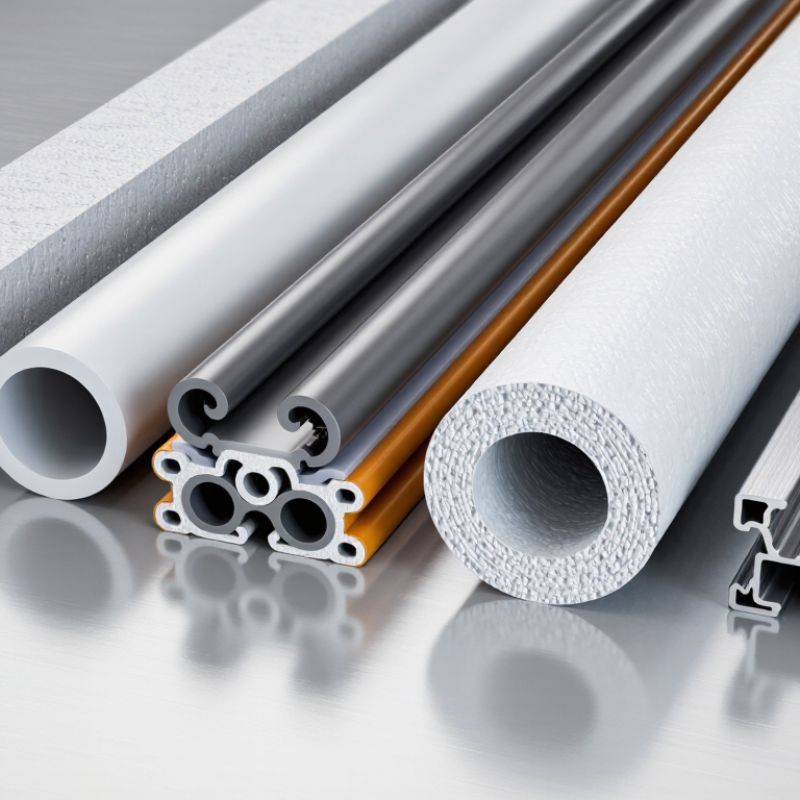
Profile extrusion is a continuous process that forms material through a shaped die. In plastic production, pellets are heated until they soften, then a screw pushes the melt through the die opening. The emerging strand is cooled, pulled at a controlled speed, and cut to length. Its cross-section stays consistent, while its length can vary. Think of a window seal or cable duct: the die shapes the small details along every metre.
For aluminum profiles, a press forces a heated billet through a die; this differs from melting plastic pellets. Solid profiles have no enclosed cavities, while hollow profiles contain internal channels. Co-extrusion can combine materials, such as a rigid base with a softer sealing edge. Small changes matter. Die temperature, cooling, and pull speed can affect dimensions, surface finish, and warping, so production often needs adjustment.
PlasticsEurope’s Plastics—the Fast Facts 2024 reports 413.8 million tonnes of global plastics production in 2023. That figure covers many processes, not extrusion alone, but it shows the scale of material supply behind products such as pipes, trims, and protective channels. Choosing a profile design means balancing shape, material behavior, and production tolerances; a complex hollow section may save weight, yet be harder to cool evenly.
Aluminum, PVC, polyethylene, ABS, polycarbonate, and thermoplastic elastomers are common choices. Each material creates different strength, flexibility, finish, and cost. Material choice matters.
Aluminum offers good strength, low weight, and useful corrosion resistance. It works well for window frames, machine guards, lighting channels, and transport parts. Surface treatment can improve durability and appearance.
PVC profiles are generally affordable, weather-resistant, and easy to process. They suit trims, seals, conduits, and drainage sections. Poor additives may cause fading, brittleness, or color changes over time.
Polyethylene suits protective edges, tubing, and sections exposed to chemicals. It provides useful toughness and flexibility. Check temperature limits carefully.
ABS provides a harder surface for housings and interior components. Polycarbonate offers impact resistance and light transmission. Thermoplastic elastomers create soft, flexible sealing lips. The softest option is not always the best.
Solid profiles suit rails, trims, and supports with simple cross-sections. Hollow profiles reduce weight and may carry air or fluids. Thin hollow walls can deform during cooling. That risk is easy to miss.
Outdoor profiles need resistance to ultraviolet exposure and temperature changes. Chemical contact, cleaning methods, operating temperature, and load also matter. Food-related applications require documented, suitable materials and cleanable geometry.
Co-extrusion combines different materials in one profile. A firm body can support a softer sealing lip. This helps with doors, enclosures, and lighting channels. However, the material interface adds process variables.
Prototype runs can reveal warping, poor fit, uneven color, and dimensional shrinkage. Testing should include temperature, load, ultraviolet exposure, and chemical contact. A profile may look perfect initially. That proves little.
Profile Extrusion is a manufacturing process that produces continuous plastic shapes by forcing a heated, softened material through a specially designed die. As the material exits the die, it is cooled, sized, and cut or coiled according to the required specifications. This method supports efficient, repeatable production of components with consistent dimensions and detailed geometries.
Profile extrusions can be classified by their cross-section, including solid, hollow, semi-hollow, flexible, and co-extruded structures. Common materials include PVC, polyethylene, polypropylene, ABS, polyurethane, and thermoplastic elastomers, with the best choice depending on strength, flexibility, temperature resistance, chemical exposure, and cost. Applications such as construction seals, window frames, tubing, protective edges, cable channels, and industrial guides determine the most suitable extrusion type. By matching the profile design and material properties to the intended use, manufacturers can achieve reliable performance, efficient production, and long service life.

 XinYe Metal