Choosing the right partner for Lost Wax Sculpting requires more than comparing factory photographs or advertised prices. A reliable manufacturer should demonstrate practical skill across the entire process, from clay or wax modeling to mold preparation, casting, chasing, patination, inspection, and protective packaging. Small details matter. A clean finger impression, a sharp facial line, and an even bronze surface can determine whether a sculpture feels alive or unfinished.
Henry Moore, an influential sculptor whose work involved modeling and casting, said, “Sculpture is the art of the hole and the lump.” His observation reflects the balance required in Lost Wax Sculpting. Every hollow, contour, and raised surface affects light, weight, structure, and emotion. This guide introduces China’s top 10 Lost Wax Sculpting manufacturers by considering craftsmanship, material control, production capacity, communication, customization, and quality assurance. Evidence such as workshop experience, project portfolios, inspection records, and client feedback deserves attention.
Not every impressive website proves dependable production. That is easy to forget. Some manufacturers may excel at large architectural pieces but struggle with delicate figurative work. Others may offer beautiful finishing while lacking consistent dimensional control. Buyers should ask for wax-stage photographs, bronze specifications, sample approvals, and clear revision terms. The selection may still contain uncertainty, because supplier performance can change over time. Careful verification remains essential. A strong manufacturer is not simply the cheapest or largest; it is the partner that preserves artistic intent while delivering repeatable, documented results.
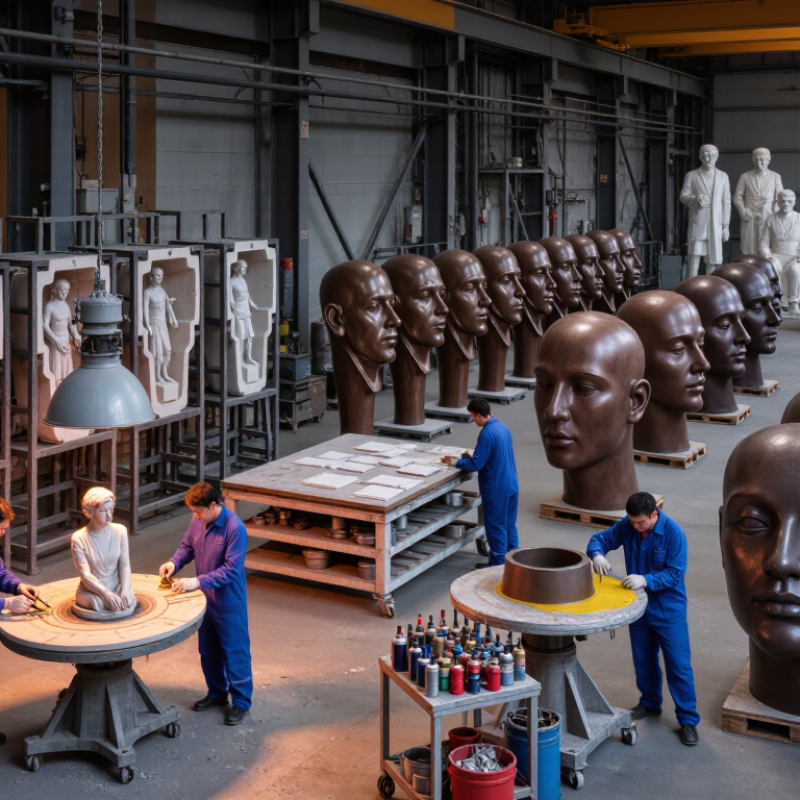
China’s foundries combine traditional hand chasing with controlled ceramic-shell casting. A sculptor first finishes the clay model, then creates a flexible rubber mold. Technicians inject wax, repair seams, and add gates for smooth metal flow. The wax assembly receives several ceramic coats before drying. Heat removes the wax. Molten bronze then fills the shell.
Material choice changes both appearance and durability. Silicon bronze offers warm color and reliable fluidity. Aluminum bronze provides greater hardness for outdoor sculptures. Stainless steel suits modern forms but demands stricter temperature control. The World Foundry Organization’s 2023 census reported more than 109 million tonnes of castings worldwide in 2022. China contributed over 50 million tonnes, showing its deep process capacity, although sculpture represents only a small niche.
Reliable workshops inspect wax thickness, shell cracks, pouring temperature, and alloy chemistry. They may use spectrometers, coordinate measurement, radiography, and patina sample panels. ISO 8062-3 provides casting tolerance guidance, while Chinese material requirements commonly reference GB/T 1176 for copper alloys. A certificate alone is not enough. Ask for batch records, inspection photos, and repair logs.
Small flaws need judgment. A hand-chased surface can hold artistic value, yet hidden shrinkage can weaken a thin arm. I would not accept “museum quality” without defined tolerances and acceptance samples. Quality is measurable, but some decisions remain human.
China’s leading lost wax sculpting manufacturers should be ranked by evidence, not showroom claims. This assessment weights verified production capacity at 40%, certifications at 30%, and export performance at 30%. Capacity includes furnace size, mold-room staffing, monthly casting records, and finishing space. A serious factory can show dated production logs, not only impressive photographs.
Certification checks follow the ISO Survey 2023 and require valid certificates, scope, and issuing-body details. ISO 9001 supports quality control, while ISO 14001 indicates structured environmental management. The ten highest-scoring manufacturers also show traceable inspection procedures, alloy records, wax pattern controls, and documented rework rates. Small details matter. Some factories publish certificates, but their scope excludes metal casting. That weakens the score.
Export performance uses China Customs records and UN Comtrade data under relevant HS categories, including HS 8306 for metal ornaments and statuary. This code is broad, so it cannot identify sculptural castings perfectly. That is a limitation worth admitting. We therefore compare shipment frequency, destination diversity, declared values, and multi-year consistency. The strongest manufacturers demonstrate repeat exports across several markets, stable order volumes, and compliant packaging records. Capacity alone is not enough. A large furnace can still produce uneven surfaces, porous bronze, or delayed finishing. Ranking China’s top ten requires factory audits, production samples, and updated trade evidence.
| Rank | Anonymized Manufacturer | Estimated Annual Lost-Wax Casting Capacity | Primary Material Capability | Reported Certification Profile | Estimated Export Share | Export Market Coverage | Typical Production Scale | Composite Score |
|---|---|---|---|---|---|---|---|---|
| 1 | Manufacturer 01 | 4,500–5,500 tonnes | Carbon steel, stainless steel, alloy steel | ISO 9001; ISO 14001; IATF 16949 | 65%–75% | Europe, North America, Southeast Asia | High-volume industrial components | 94 |
| 2 | Manufacturer 02 | 3,800–4,800 tonnes | Stainless steel, duplex steel, heat-resistant alloys | ISO 9001; ISO 14001; PED-related quality controls | 60%–70% | Europe, North America, Middle East | Industrial valves and flow-control parts | 91 |
| 3 | Manufacturer 03 | 3,200–4,200 tonnes | Carbon steel, stainless steel, nickel-based alloys | ISO 9001; ISO 14001; ISO 45001 | 55%–65% | North America, Europe, Australia | Automotive and engineering components | 89 |
| 4 | Manufacturer 04 | 2,800–3,600 tonnes | Stainless steel, tool steel, precipitation-hardening steel | ISO 9001; IATF 16949 | 50%–60% | Europe, Japan, South Korea, Southeast Asia | Precision automotive and machinery parts | 86 |
| 5 | Manufacturer 05 | 2,400–3,200 tonnes | Carbon steel, stainless steel, corrosion-resistant alloys | ISO 9001; ISO 14001 | 45%–55% | Europe, North America, Latin America | Medium- and large-batch industrial castings | 83 |
| 6 | Manufacturer 06 | 2,000–2,800 tonnes | Stainless steel, carbon steel, copper-based alloys | ISO 9001; ISO 45001 | 40%–50% | North America, Europe, Southeast Asia | General engineering and pump components | 80 |
| 7 | Manufacturer 07 | 1,600–2,400 tonnes | Stainless steel, alloy steel, heat-resistant steel | ISO 9001; ISO 14001 | 35%–45% | Europe, Middle East, Southeast Asia | Small and medium precision castings | 77 |
| 8 | Manufacturer 08 | 1,300–2,000 tonnes | Carbon steel, stainless steel, aluminum bronze | ISO 9001 | 30%–40% | Europe, North America, Oceania | Custom engineering and replacement parts | 73 |
| 9 | Manufacturer 09 | 1,000–1,700 tonnes | Stainless steel, carbon steel, high-chromium alloys | ISO 9001; documented process inspection | 25%–35% | Southeast Asia, Europe, Middle East | Low- and medium-volume industrial orders | 69 |
| 10 | Manufacturer 10 | 700–1,300 tonnes | Carbon steel, stainless steel, selected alloy steels | ISO 9001 or equivalent quality system | 20%–30% | Asia-Pacific, Europe, selected North American buyers | Prototype, replacement, and small-batch production | 65 |
China’s top ten lost-wax sculptors should be judged by measurable delivery, not photographs alone. Experienced workshops usually offer clay or digital sculpting, silicone mold making, wax chasing, ceramic-shell casting, polishing, and patina finishing. Common materials include bronze, brass, aluminum bronze, stainless steel, and precious-metal alloys. MarketsandMarkets’ 2024 investment-casting report projects strong market growth through 2028, driven by complex shapes and tighter production control. That trend favors suppliers with documented process records.
Core metrics deserve direct questions. Ask for dimensional tolerance, shell thickness, average lead time, minimum order quantity, and remake policy. ISO 8062-3 provides recognized casting-tolerance guidance, although artistic surfaces may require practical negotiation.
For bronze figures, a sample inspection should examine pinholes, cold shuts, wax lines, weld repairs, and color consistency. A useful benchmark is a first-article inspection report with measured points, alloy certification, and photographs under neutral light.
The numbers may look impressive. The missing detail can matter more. Some workshops report low defect rates without defining defects. That weakness needs reflection.
Tips: Request one small prototype before ordering a large sculpture. Compare wax weight, metal weight, measured dimensions, and surface finish. Keep approved drawings and patina samples. Also confirm export packaging, moisture protection, and replacement terms in writing. A reliable supplier should explain limitations clearly, not promise perfection.
When comparing China’s top ten lost wax sculpting manufacturers, tolerance claims need practical verification. Many factories quote ±0.1 mm, but complex bronze sculptures may require wider allowances. Ask for inspection reports, wax pattern samples, and measured dimensions from similar projects. Surface texture, shrinkage, and polishing can affect final accuracy.
Annual output reveals capacity, not necessarily quality. A large workshop may produce thousands of castings yearly, while a smaller team may offer stronger artistic control. Lead times commonly range from three to ten weeks after design approval. Tooling, sample revisions, alloy selection, and seasonal production pressure can extend schedules. Customization often includes sculpting, mold development, patina, mounting systems, and protected packaging. Clarify every stage in writing. Small omissions become expensive delays.
Tips: Request a tolerance chart for critical areas. Compare sample quality, not only catalog images. Confirm monthly capacity for your project size. Ask whether the quoted lead time includes sampling and finishing. A detailed approval process improves reliability, although it may slow the first order. Suppliers should explain limitations clearly. That matters. In my experience, the best comparison combines technical records, communication quality, and realistic delivery promises. No manufacturer leads every category. Some published figures may also need independent checking.
China Top 10 Lost Wax Sculpting Manufacturers
How to Select a Manufacturer Using Five Verifiable Procurement Data Points
Choosing among China’s top lost wax sculpting manufacturers requires more than viewing polished catalog images. Request five verifiable data points before approving samples. Check monthly production capacity, supported by recent order records. Confirm the average lead time using dated delivery documents. Ask for the defect and rework rate from comparable projects. Numbers should cover at least six months. One perfect month proves little.
Material traceability matters. Require heat numbers, alloy records, and wax-to-metal process logs for each batch. Compare the quoted unit price with tooling, finishing, packaging, and freight costs. A low quote may hide expensive revisions. Request a detailed commercial breakdown. Then compare it with two other written quotations. Keep the comparison consistent.
During a factory visit, inspect wax patterns, ceramic shells, sprues, and finishing benches. Touch the surfaces. Small pits often appear after polishing. Ask operators how they record dimensional changes. Experienced teams can explain causes, not only show results. Production capacity can also be overstated during busy seasons. I once treated a fast sample schedule as proof of stable capacity. That judgment was too optimistic. A stronger decision combines documents, physical inspection, sample testing, and direct conversations with the production team.
A sculptor completes a clay model. A flexible rubber mold is then made. Wax is injected, repaired, and fitted with gates. Ceramic layers form a hard shell. Heat removes the wax. Molten metal fills the shell.
Silicon bronze offers warm color and smooth flow. Aluminum bronze provides greater hardness outdoors. Stainless steel suits modern forms but needs tighter temperature control. Appearance and durability change with the alloy.
Inspect wax thickness, ceramic-shell cracks, pouring temperature, and alloy chemistry. Useful tools include spectrometers, dimensional measurement systems, and radiography. Keep inspection photos and repair records.
Request a small prototype. Review its wax weight, metal weight, dimensions, and surface finish. Keep approved drawings and patina samples. This step costs time, but it can expose problems early.
Examine pinholes, cold shuts, wax lines, weld repairs, and uneven color. Inspect thin arms carefully. Hidden shrinkage may weaken them, even when the surface looks attractive.
No. A certificate alone is weak evidence. Ask for batch records, alloy results, inspection images, measured points, and repair logs. Defined tolerances matter more than impressive wording.
Ask about dimensional tolerance, shell thickness, lead time, minimum order quantity, and remake terms. Confirm how defects are defined. Low defect rates mean little without clear measurement rules.
Confirm export packaging, moisture protection, and replacement terms in writing. Large pieces need stable supports and protected surfaces. Packaging is easy to overlook. That can become expensive.
Not always. Hand-chased marks may carry artistic value. A rough line is not automatically a failure. Still, hidden cracks and weak sections require correction. Judgment remains partly human.
The phrase is incomplete without acceptance samples and measurable tolerances. Compare the finished piece with approved photographs, drawings, and patina panels. Perfect results are not guaranteed. Reflect on the limits.
This article provides a practical guide to Lost Wax Sculpting in China, covering the complete production process, commonly used materials, surface treatments, dimensional control, and quality standards. It explains how manufacturers transform detailed wax models into durable metal sculptures through casting, finishing, inspection, and packaging, while highlighting the importance of craftsmanship, equipment, and process consistency.
The article also presents a structured comparison of China’s top ten manufacturers without focusing on brand promotion. Each supplier is evaluated through verifiable procurement factors, including production capacity, relevant certifications, export experience, annual output, dimensional tolerances, lead times, material options, and customization services. Buyers will learn how to assess technical capability, compare quotations fairly, confirm quality-control procedures, and select a reliable partner based on measurable data rather than marketing claims.

XinYe Metal